

Forewords
Today, I read this post from the Hacker News, which leads me to this article (warning: paid Medium article) about a new proof of the Pythagorean Theorem that uses trigonometry.
It is said that proving the Pythagorean Theorem with trigonometry is impossible. I haven’t been involved in Math long enough to see where it is stated, but I can guess that it is because the idea of trigonometry is built on top of the perpendicular triangle, and many of its characteristic is derived from the theorem in question. For example, the famous fomular is a direct result of that theorem.
Reading through the article and the idea of the proof, I am amazed by the approach. It is indeed using the function, some of its characteristic, but in noway it requires the preconditions of the Pythagorean Theorem.
On one hand, I believe it is a correct and beautiful approach, and I’m so excited that given a very old and well-known problem with such a huge number of existing solutions, one can still find a new way to do it.
But on the other hand, from what I can read in the article, the approach includes the use of geometry series to calculate the sides of the big triangle. While it is possible, it requires some advance steps such as: (A) you need to explain the way you construct new triangles, prove that the new vertexes are all on the same line (which is the new edges), prove that it will be smaller and smaller and meet at a point, and (B) relying on the sum of an infinite series, which requires not only extra knowledge, but also more proofs (of the sum of the series) are needed.
It is hard to complaint a new proof of such a well-known problem. If I try to simplify the proof carelessly, I can easily make it another existing proof, and it is not the point. In this article, I think the original idea can be converted to a pure Geometry solution. This way, any concern I have above are gone.
- All of my acknowledge about the proof is from the article https://keith-mcnulty.medium.com/heres-how-two-new-orleans-teenagers-found-a-new-proof-of-the-pythagorean-theorem-b4f6e7e9ea2d.
- I don’t have any direct access to the original author of the proof, or their publishing as well.
- This article doesn’t try to take the credit of their idea. I only write it because I want to have a better version of it that fulfills my desire. I think the original idea is briliant.
Proving the Pythagorean Theorem
The Pythagorean Theorem
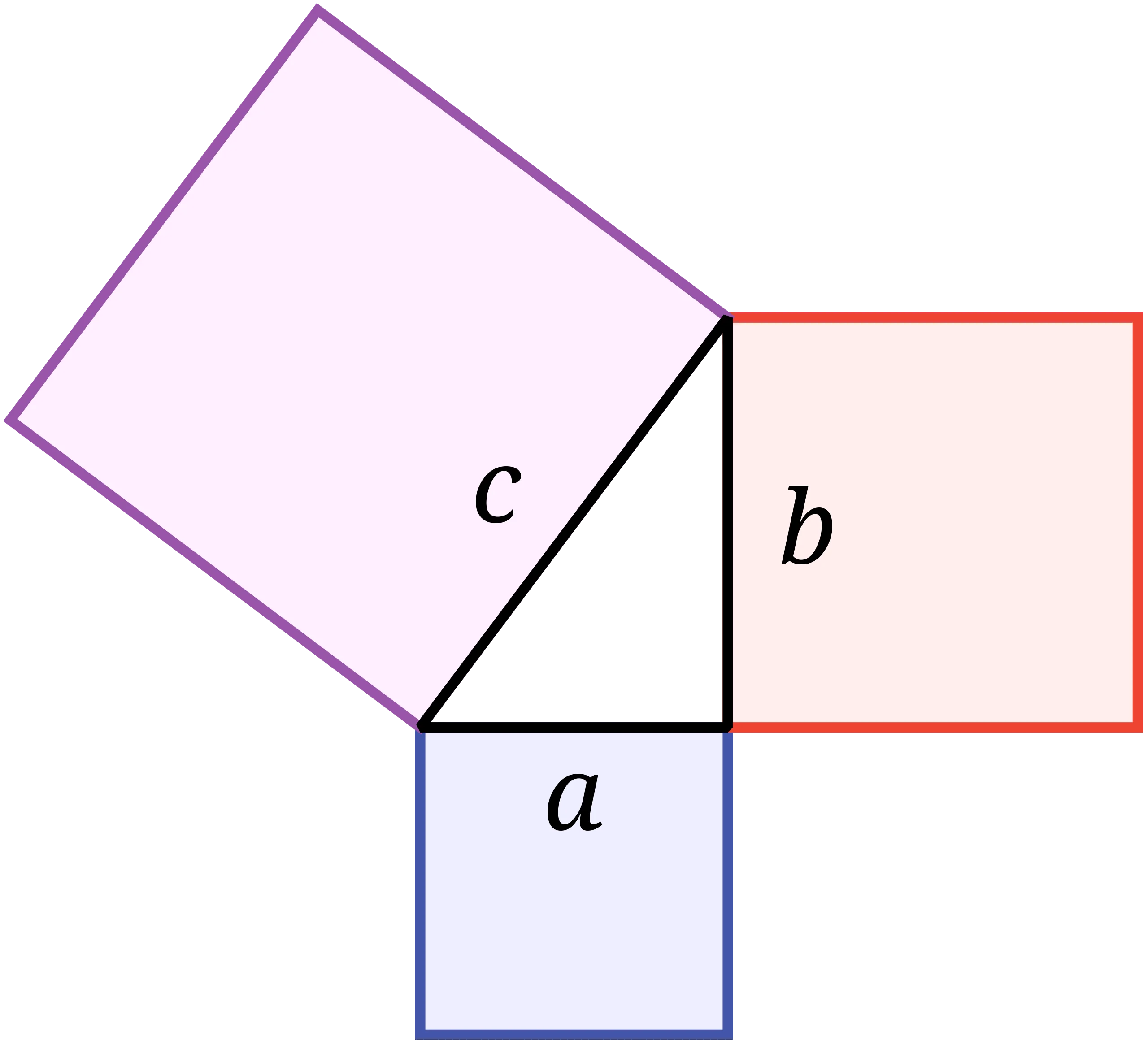
The square of the longest side (the hypotenuse, or c in the above diagram) is equal to the sum of the squares of the other two sides. So .
The proof
The original proof mentioned in the article above doesn’t solve the case where . It cannot, because in that case, the 2 sides are parallel and their length become infinite.
By the way, that case is trivial: the triangle is a one-fourth of a square whose side length is . The area of this square is , while the triangle’s area is . Therefore , as desired.
When : denote the vertixes of the triangles and the side lengths are , we need to prove that .
Let the angle . WLOG, we can assume that .
Let be the point on the line such that is the midpoint of . We have because they shares the same side , the sides and (they are equal to ). This gives us or in the Figure B.
Since and then , and therefore , which means that if we draw a line that is perpendicular to at , would never be parallel with the line and they cut each other at a point like the Figure B.
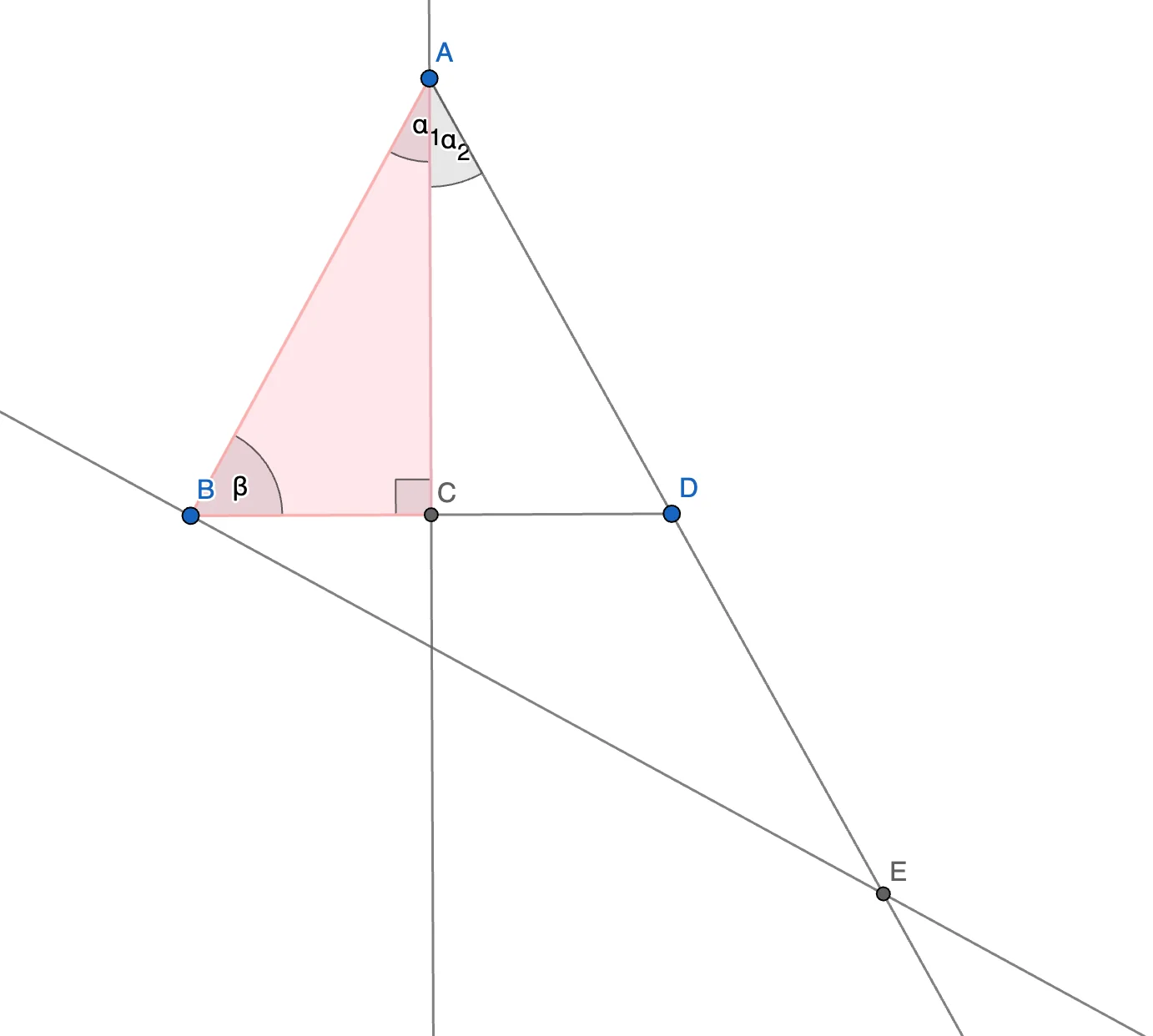
Now, let be the intersection of line and
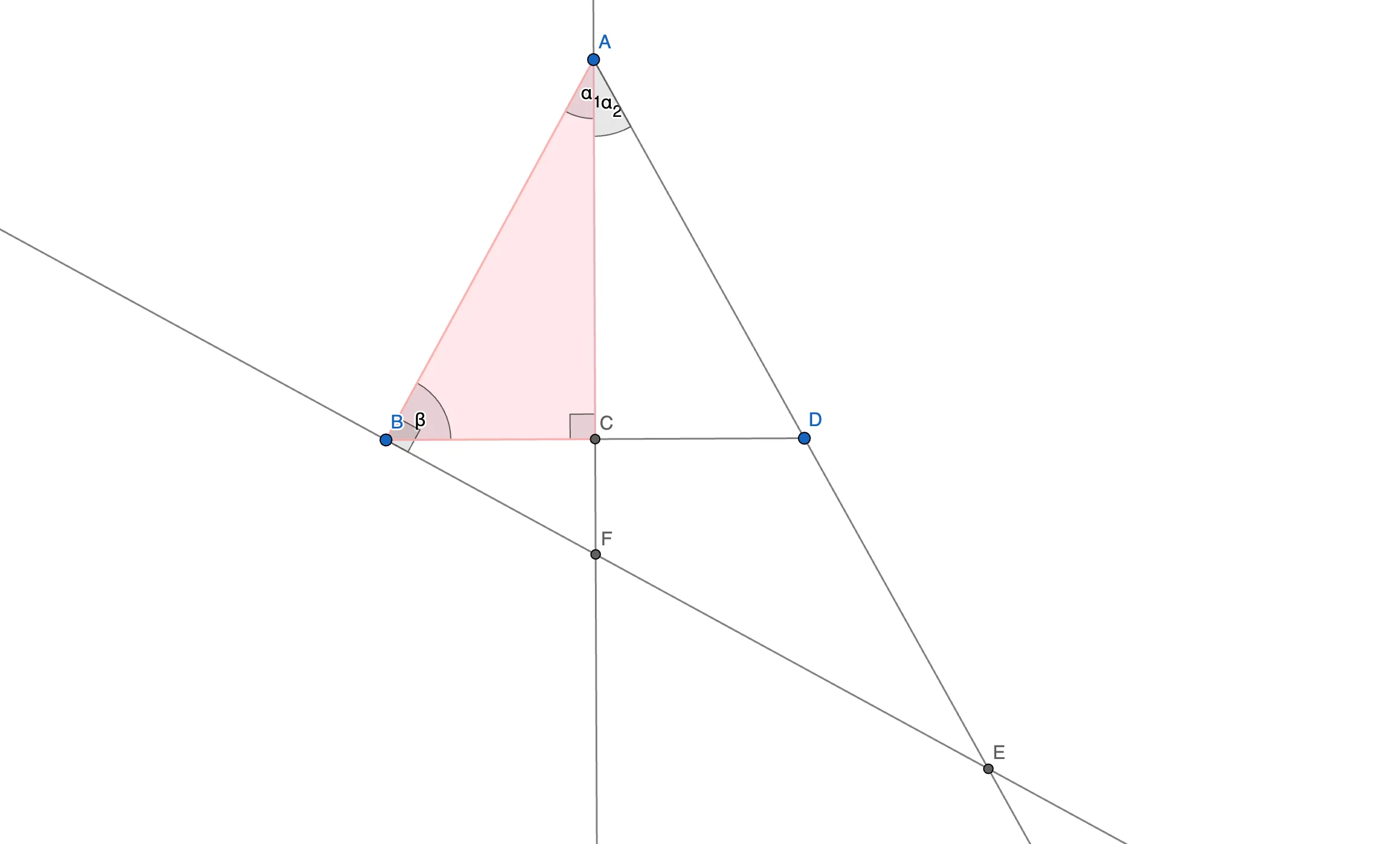
Because of , (or ) is the bisector of . With this, we have:
Now notice that and are similar because they share the same angle , and they are both perpendicular triangles, therefore:
From and :
Next, let be the altitude of and be the altitude of (see the Figure D below):
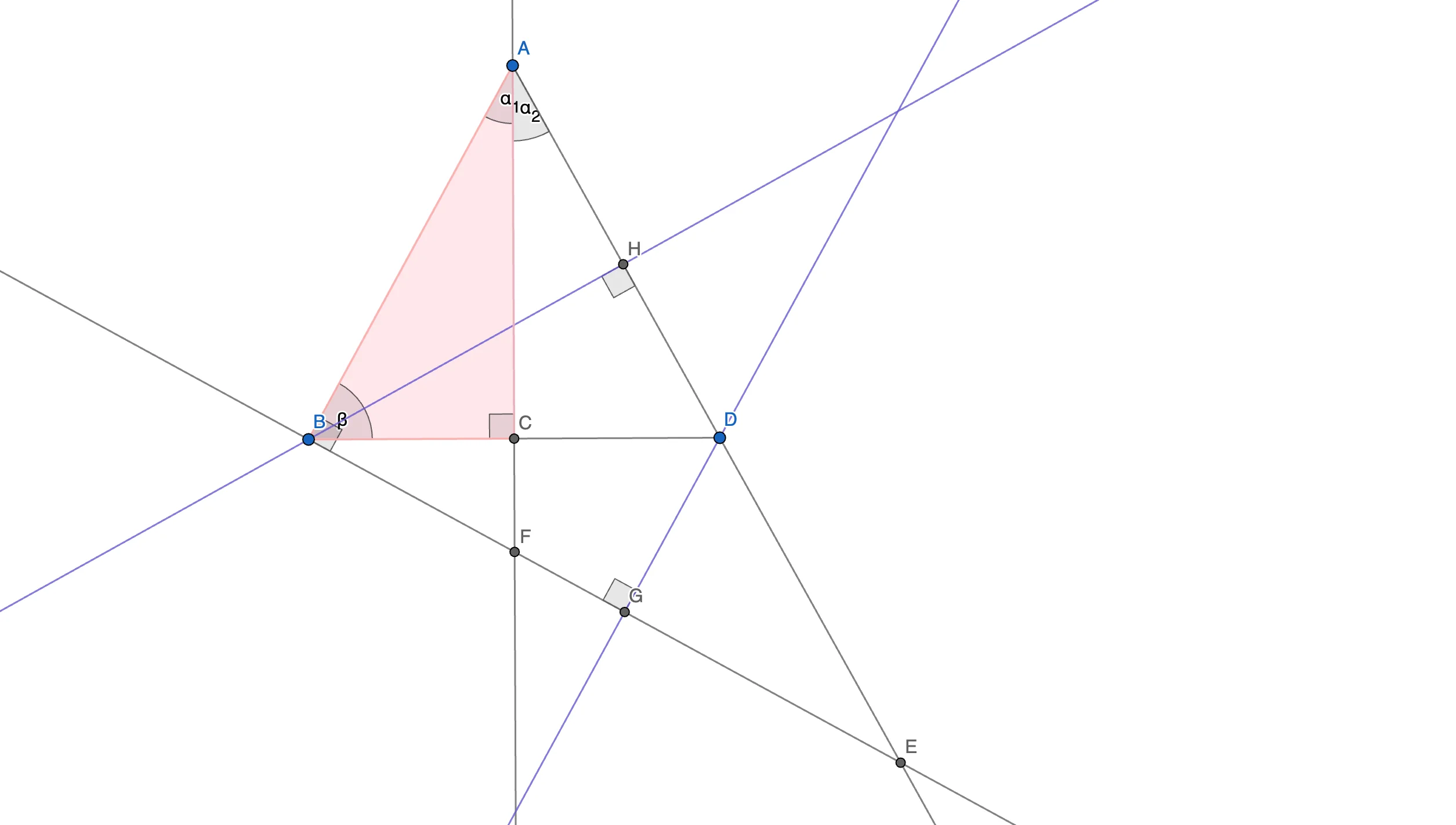
If is the area of then , i.e.,
Since and , we have , therefore:
( because is the midpoint of as we defined it, and ).
If is the area of then , which gives us:
And since (see above), we have . Hence:
From and , we have
Now, because is a perpendicular triangle with , and is also an altitude of , we have where is the area of . This equation gives us:
From and , we have
Which is .